


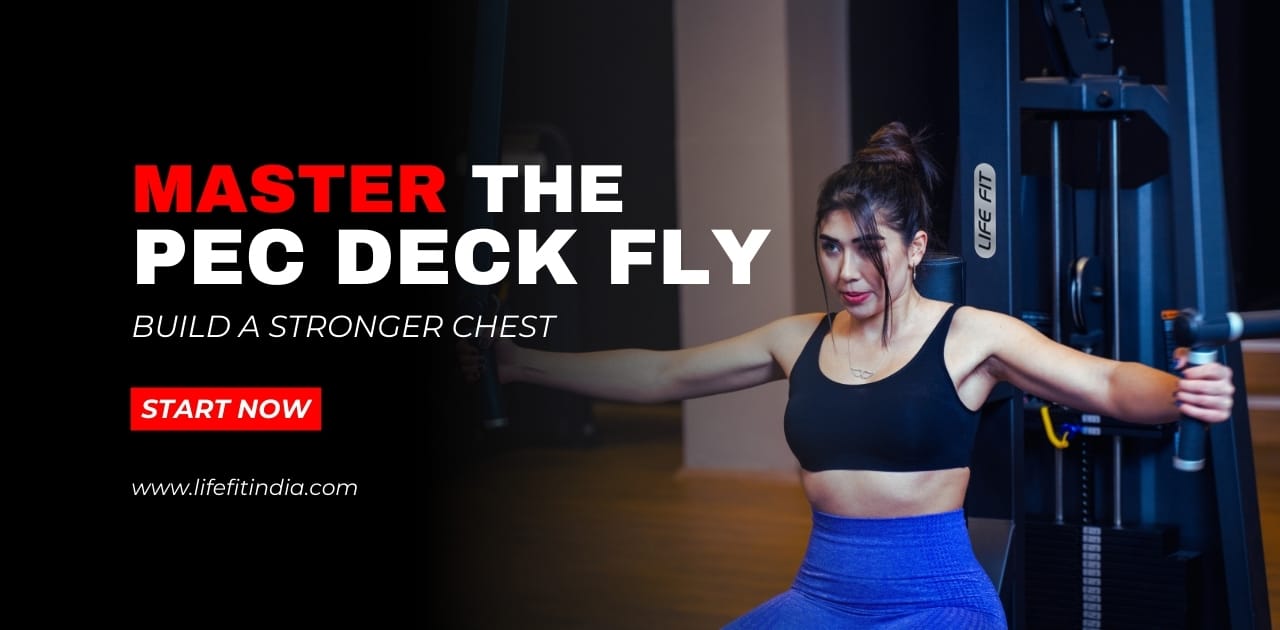
The pec deck fly is a machine-based chest isolation exercise that trains the pectoralis major by bringing the upper arms toward the centre of the body.
To perform it correctly, adjust the seat so the handles or elbow pads sit approximately in line with your mid-chest. Keep your back supported, maintain a soft bend in your elbows and bring your arms together without shrugging or forcefully rolling your shoulders forward.
The machine’s guided path makes the movement relatively easy to learn, but seat position, starting depth and weight selection still determine whether the exercise feels effective or uncomfortable.
Pec Deck Fly at a Glance
Exercise detail | Information |
|---|---|
Primary muscle | Pectoralis major |
Supporting muscles | Anterior deltoid, coracobrachialis and shoulder stabilisers |
Exercise type | Machine-based isolation exercise |
Main movement | Horizontal shoulder adduction |
Equipment needed | Pec deck or machine fly |
Difficulty level | Beginner to advanced |
Common rep range | Approximately 8–20 repetitions |
Best used for | Targeted chest training and additional workout volume |
What Is the Pec Deck Fly?
The pec deck fly is performed on a seated resistance machine designed to guide the arms through a chest-fly movement.
Depending on the machine, you may:
Grip handles with your hands.
Place your forearms against padded levers.
Adjust the starting angle of the machine arms.
Perform the exercise bilaterally or one arm at a time.
During the movement, your upper arms travel toward the centre of your chest. This action is known as horizontal shoulder adduction, one of the primary functions of the pectoralis major.
The machine is also commonly called a:
Pec deck machine
Chest fly machine
Butterfly machine
Seated machine fly
Some dual-function machines can also be used for the reverse pec deck, but that is a different exercise targeting the rear shoulders and upper back.
Pec Deck Fly Versus Reverse Pec Deck
The pec deck fly and reverse pec deck may use the same machine, but their movement patterns and target muscles are different.
Exercise | Direction of movement | Main muscles |
|---|---|---|
Pec deck fly | Arms move forward and inward | Pectoralis major |
Reverse pec deck | Arms move backward and outward | Rear deltoids and upper-back muscles |
For the chest fly variation, you face away from the machine stack with your back against the pad.
For the reverse pec deck, you usually face the machine pad and move the arms outward and backward.
Always check the machine’s adjustment markings before beginning because the starting position may need to be changed when switching between the two exercises.
Muscles Worked During the Pec Deck Fly
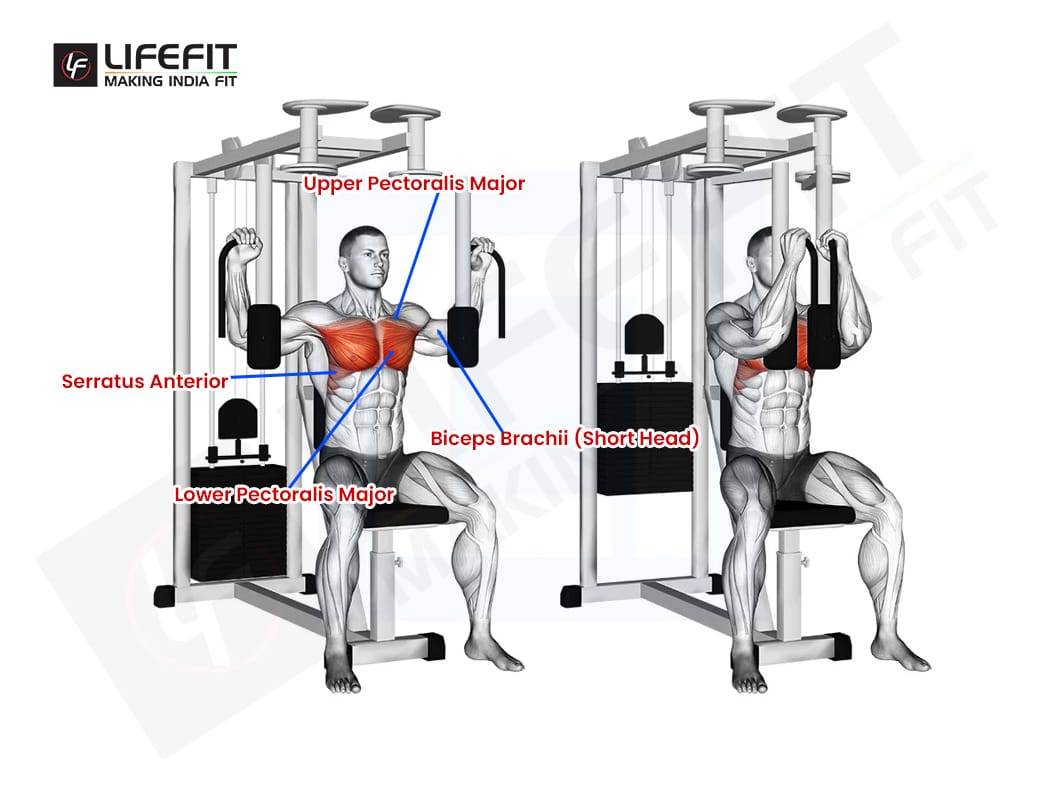
Primary muscle: Pectoralis major
The main muscle trained during the pec deck fly is the pectoralis major, the large fan-shaped muscle covering the front of the chest.
Its major anatomical regions include:
The clavicular region near the upper chest
The sternocostal region across the middle and lower portion of the chest
Both regions contribute to the movement. The exact distribution of muscular effort can vary with the machine design, seat height, arm path and individual anatomy.
The pectoralis major helps move the upper arm toward the centre of the body, internally rotate the upper arm and assist with several pressing and throwing movements.
You can learn more about its anatomy in the StatPearls overview of the pectoralis major.
Supporting muscles
Other muscles contribute to the movement or help maintain joint position:
Anterior deltoid: Assists with moving the upper arm forward and inward.
Coracobrachialis: Assists shoulder flexion and adduction.
Serratus anterior: Contributes to shoulder-blade control.
Rotator cuff muscles: Help stabilise the shoulder joint.
Abdominal and trunk muscles: Help maintain a steady seated position.
The pec deck is still predominantly a chest exercise. Supporting muscles assist the movement but should not become the main source of effort.
Benefits of the Pec Deck Fly
1. Direct chest training
The pec deck allows you to train the pectoralis major without the substantial triceps contribution required during pressing exercises.
This makes it useful when you want to add targeted chest work after a compound exercise such as the barbell bench press or incline dumbbell press.
An American Council on Exercise-sponsored electromyography comparison found high pectoralis major activity during the pec deck. However, muscle activation data should not be interpreted as proof that one exercise will always produce more muscle growth than another.
2. Stable exercise setup
Your back remains supported, and the machine guides the resistance through a predetermined path.
This reduces balance and coordination demands compared with a standing cable fly or dumbbell fly. The added stability can help beginners concentrate on controlling the chest rather than managing several moving joints at once.
A guided path does not automatically make the exercise suitable for every shoulder. Comfort still depends on:
Machine design
Seat adjustment
Starting angle
Training load
Individual joint structure
3. Easy load adjustment
Most pec deck machines use a selectorised weight stack. You can increase or reduce resistance without carrying dumbbells or setting up additional equipment.
This is especially useful for:
Drop sets
Higher-repetition finishing sets
Warm-up sets
Progressive overload
Training close to fatigue without a spotter
4. Consistent movement pattern
The machine makes it easier to repeat a similar arm path from one repetition to the next.
This consistency can help you monitor:
Training load
Repetition quality
Range of motion
Tempo
Progress over time
5. Resistance through much of the movement
Many pec deck machines maintain meaningful resistance through a larger portion of the movement than a traditional dumbbell fly.
The exact resistance curve depends on the lever, cable and cam design of the machine. It is therefore more accurate to say that many pec decks provide sustained resistance rather than perfectly constant tension.
6. No spotter required
Because the resistance remains controlled by the machine, you can usually end the set safely by returning the weight stack to its resting position.
This makes the pec deck convenient for people training alone.
How to Adjust the Pec Deck Machine
Correct setup should be completed before selecting a demanding weight.
1. Adjust the seat height
Set the seat so the handles or elbow pads align approximately with the middle of your chest.
Your upper arms will generally be around shoulder height or slightly below, depending on the design of the machine.
If the seat is too low, your shoulders may rise toward your ears.
If the seat is too high, the movement may shift downward and feel awkward through the shoulder or upper arm.
2. Adjust the starting position
If the machine allows you to change the starting angle, select a position that creates a comfortable chest stretch without forcing the upper arms excessively behind the torso.
More range of motion is not automatically better.
The correct starting position is the deepest position you can control while keeping:
Your back supported
Your shoulders comfortable
Your ribcage stable
The weight under control
3. Choose an appropriate weight
Begin with a load you can control for at least 10 smooth repetitions.
The final repetitions should feel challenging, but the weight should not cause you to:
Jerk the handles
Lift your back from the pad
Shrug your shoulders
Shorten the movement substantially
Allow the weight stack to crash
4. Check the handle or pad position
On a handle-based machine, keep your wrists relatively neutral and grip the handles without excessive tension.
On a padded pec deck, place the forearms comfortably against the pads. Avoid pressing only through the hands if the machine is designed to be driven through the elbows and forearms.
How to Perform the Pec Deck Fly
1. Establish your starting posture
Sit with your back and upper torso supported by the pad.
Place your feet firmly on the floor and gently brace your trunk as though preparing to absorb a light impact.
Keep your chest naturally lifted without excessively arching your lower back.
Your shoulders should remain comfortable and controlled. Avoid aggressively forcing the shoulder blades together throughout the entire set.
2. Set your arms
Hold the handles or position your forearms against the pads.
Maintain a small and consistent bend in your elbows. The elbow angle should remain nearly unchanged throughout the repetition.
Changing the elbow angle turns the movement into a partial press and reduces the consistency of the fly pattern.
3. Bring the arms together
Drive your upper arms forward and inward in a smooth arc.
Think about bringing your biceps or elbows toward the centre of your chest rather than pushing only with your hands.
Exhale gradually as your arms move together.
4. Finish the repetition under control
Stop when your arms have come together as far as the machine comfortably allows.
The handles do not need to collide or cross over for the repetition to be effective.
Pause briefly if you can maintain tension without:
Rounding your shoulders excessively
Losing contact with the back pad
Allowing the weight stack to rest
5. Return slowly
Allow your arms to open gradually until you feel a controlled chest stretch.
Inhale during the return.
Do not let the resistance pull your shoulders suddenly into the starting position. The return should remain controlled rather than deliberately exaggerated or excessively slow.
6. Repeat with consistent technique
Continue until you reach the planned number of repetitions or can no longer maintain the same movement quality.
End the set when your technique begins to change substantially.
Pec Deck Fly Form Checklist
Before every working set, check the following:
Seat adjusted to align the handles with your mid-chest
Back supported by the pad
Feet planted firmly
Trunk gently braced
Elbows softly bent
Shoulders not shrugged
Starting position comfortable
Weight moved without momentum
Return phase controlled
No sharp or worsening shoulder pain
Common Pec Deck Fly Mistakes
1. Setting the seat too high or too low
Incorrect seat height changes the line of movement and may make the shoulders or arms work harder than intended.
How to fix it: Adjust the seat until the handles or pads align approximately with the middle of your chest. Your shoulders should not feel forced upward.
2. Starting too far behind the body
A deeper starting position may feel like a greater stretch, but it can also place the shoulder in an unnecessarily demanding position.
How to fix it: Reduce the starting angle. Use the largest range you can control without pain, instability or sudden pulling across the front of the shoulder.
3. Using too much weight
Excessive resistance often causes lifters to jerk the machine, shorten the range or push their torso away from the pad.
How to fix it: Reduce the load until you can move the resistance smoothly and complete each repetition without momentum.
4. Letting the shoulders shrug
Raising the shoulders toward the ears can increase neck and upper-trapezius tension.
How to fix it: Keep your neck relaxed and shoulders away from your ears. Do not force them unnaturally downward; simply avoid shrugging as fatigue increases.
5. Rounding the shoulders aggressively
Some natural shoulder-blade movement can occur, but forcefully collapsing the chest and rolling the shoulders forward may reduce comfort and control.
How to fix it: Keep your upper torso supported and stop the inward movement before your posture breaks down.
6. Changing the elbow angle
Straightening and bending the elbows during each repetition changes the exercise into a combination of a fly and press.
How to fix it: Establish a soft elbow bend at the beginning and maintain approximately the same angle throughout the set.
7. Slamming the handles together
Allowing the handles to collide removes control and may create unnecessary stress on the machine and joints.
How to fix it: Finish each repetition smoothly. The goal is muscular tension, not making the handles touch with maximum force.
8. Allowing the weight stack to crash
Letting the plates strike between repetitions reduces muscular control and creates noise without improving the exercise.
How to fix it: Reverse the movement just before the plates make full contact, unless the machine design requires a reset.
9. Using an excessively short range
A very heavy weight may tempt you to perform only the easiest middle portion of the movement.
How to fix it: Reduce the resistance and use a comfortable but meaningful range. Partial repetitions can be used deliberately, but they should not replace full controlled repetitions unintentionally.
How Many Sets and Reps Should You Do?
Muscle growth can occur across a relatively broad range of repetitions when sets are sufficiently challenging and total training volume is appropriate.
The following recommendations are practical starting points rather than rigid rules.
Training goal | Sets | Repetitions | General approach |
|---|---|---|---|
Learning technique | 2–3 | 12–15 | Light load and controlled movement |
General muscle growth | 2–4 | 8–20 | Stop with approximately 1–3 good reps remaining |
High-rep finishing work | 1–3 | 15–25 | Moderate-to-light weight |
Warm-up or activation | 1–2 | 12–20 | Low fatigue and smooth repetitions |
A systematic review published in Sports Medicine found that muscle growth can occur across different loading ranges, while heavier loads tend to be more advantageous for developing maximal strength.
Because the pec deck is generally used as an isolation exercise, moderate and higher repetition ranges are often practical and comfortable.
Where Should the Pec Deck Go in Your Workout?
The pec deck is commonly performed after your primary pressing movements.
A typical chest session might include:
Barbell bench press
Incline dumbbell press
Pec deck fly
Push-up or cable-finishing exercise
Performing compound exercises first allows you to train them while fresh. The pec deck can then add focused chest volume without requiring as much coordination or triceps strength.
You can also use the pec deck earlier in the workout when:
Chest isolation is the main priority.
You are learning how to feel the pectoral muscles working.
Pressing movements are limited or uncomfortable.
You are using a planned pre-exhaust technique.
Pre-exhaust training is not automatically more effective. It is simply one programming option and may reduce performance during subsequent presses.
How Often Can You Train the Pec Deck Fly?
Most people can include the pec deck one to three times per week, depending on:
Total chest-training volume
Recovery
Training experience
Proximity to muscular failure
Other pressing and fly exercises
Shoulder comfort
The exercise does not need to appear in every chest workout.
Progress can be created by gradually increasing:
Repetitions
Weight
Number of sets
Movement control
Comfortable range of motion
Avoid increasing every variable at the same time.
Should You Squeeze at the Centre?
A deliberate contraction at the end of the repetition can help you maintain focus and prevent the movement from becoming rushed.
However, squeezing harder does not isolate a separate “inner chest” muscle.
The pectoralis major works as a connected muscle. You cannot independently isolate an anatomically separate inner or outer chest simply by holding the handles together.
Use the end position to maintain control—not to force the shoulders forward or create an exaggerated contraction.
Can Seat Height Target the Upper or Lower Chest?
Changing the seat height alters the position of the arms relative to the torso and may change how the exercise feels across different pectoral regions.
However, the pec deck is not infinitely adjustable, and a small seat change does not completely isolate the upper or lower chest.
For more deliberate angle variation, exercises such as an incline press, low-to-high cable fly or high-to-low cable fly may provide more flexibility.
Avoid setting the seat so high or low that the shoulder position becomes uncomfortable merely to chase a different sensation.
Single-Arm Pec Deck Fly
A single-arm pec deck fly can be used to train one side at a time.
Potential benefits include:
Comparing left and right-side control
Giving extra attention to one side
Increasing trunk-stability demands
Using a slightly different range where the machine permits
Keep your torso against the pad and avoid rotating toward the working arm.
The non-working hand can hold the seat or machine frame for stability, provided the manufacturer allows it.
Start with less than half of your usual two-arm load because unilateral execution may feel considerably more demanding.
Pec Deck Fly Versus Dumbbell Fly
Both exercises train the chest through a fly-type movement, but their resistance profiles and stability demands differ.
Feature | Pec deck fly | Dumbbell fly |
|---|---|---|
Stability | High | Lower |
Resistance direction | Determined by machine | Determined by gravity |
Most demanding area | Depends on machine design | Usually the stretched or lower position |
Setup | Quick weight-stack adjustment | Requires dumbbells and bench |
Coordination demand | Lower | Higher |
Spotter needed | Usually no | Usually no, but safe handling is important |
Angle options | Limited by machine | Adjustable with bench position |
The dumbbell fly provides greater freedom of movement, but that freedom also requires more shoulder control.
Neither exercise is universally superior. The best option is the one you can perform comfortably, progressively and consistently.
Pec Deck Fly Versus Cable Fly
Cable flies provide more freedom to adjust:
Pulley height
Arm path
Body position
Training angle
Unilateral range of motion
A pec deck offers more external stability and generally requires less setup.
A cable crossover or functional trainer may be more suitable when you want to experiment with different resistance angles.
The pec deck may be preferable when your priority is a stable, repeatable seated movement.
Pec Deck Fly Versus Bench Press
The bench press and pec deck serve different purposes.
Feature | Pec deck fly | Bench press |
|---|---|---|
Exercise type | Isolation | Compound |
Main muscles | Primarily chest | Chest, triceps and anterior deltoids |
Strength potential | Moderate | High |
Stability demand | Low | Higher |
Spotter consideration | Usually unnecessary | Recommended for heavy free-weight sets |
Typical role | Additional chest volume | Primary strength and mass exercise |
The pec deck should not be viewed as a complete replacement for pressing exercises when overall pressing strength is an important goal.
However, it can remain a valuable chest exercise for people who cannot or do not want to perform heavy free-weight presses.
Is the Pec Deck Fly Safe for Your Shoulders?
No exercise is universally safe or unsafe for every person.
The guided movement may reduce balance demands, but the fixed path can feel comfortable for one person and restrictive for another.
To make the exercise more shoulder-friendly:
Use a comfortable starting angle.
Avoid forcing the upper arms far behind the torso.
Use a manageable weight.
Keep the movement smooth.
Stop before posture breaks down.
Avoid training through sharp, catching or worsening pain.
If the exercise repeatedly causes pain despite reasonable adjustments, select another chest exercise and consider consulting a qualified healthcare or exercise professional.
The goal is not to force your body to match the machine. The machine should be adjusted to suit your comfortable movement range.
Pec Deck Machine Variations
Handle-based machine fly
You hold vertical or horizontal handles and maintain a soft elbow bend.
This variation may allow greater freedom in wrist and elbow position, depending on the handle design.
Forearm-pad pec deck
Your elbows and forearms press against padded levers.
This setup reduces the need to grip firmly and may make it easier to focus on moving through the upper arms.
Dual-function pec deck
This machine performs both chest fly and reverse-fly movements.
Always confirm the selected starting position and seat orientation before beginning.
Plate-loaded pec deck
Instead of a selectorised stack, resistance plates are added directly to the machine.
Plate-loaded machines may have a different resistance curve and may require loading both sides evenly.
Who Should Use the Pec Deck Fly?
The pec deck may be useful for:
Beginners learning the chest-fly movement
Experienced lifters adding chest volume
People training without a spotter
Bodybuilders seeking targeted pectoral work
Home and commercial gym users
Lifters who prefer machine stability
People performing unilateral chest training
It may be less suitable when:
The machine’s fixed path feels uncomfortable.
The starting position cannot be adjusted appropriately.
Shoulder pain persists during the movement.
The available machine does not suit your limb length or body size.
Frequently Asked Questions
The pec deck fly primarily trains the pectoralis major. The anterior deltoid, coracobrachialis, rotator cuff and other shoulder-stabilising muscles also contribute.
Yes. The pec deck can contribute to chest muscle growth when it is performed with progressive resistance, sufficient effort, appropriate weekly volume and adequate recovery.
It should usually be combined with other chest movements rather than treated as the only exercise required.
Adjust the seat so the handles or elbow pads align approximately with the middle of your chest. Your upper arms will normally sit around shoulder height or slightly below.
The correct position is one that allows a comfortable chest-focused movement without shrugging.
The handles may touch on some machines, but they do not need to collide for the exercise to be effective.
Bring your arms together as far as you can while maintaining chest tension, shoulder comfort and control.
Return until you feel a controlled chest stretch without pain or instability.
Do not force your upper arms excessively behind your torso. Your comfortable range may change depending on the machine.
Your torso should remain supported and your shoulders controlled, but you do not need to forcefully pin the shoulder blades together throughout the entire movement.
Avoid excessive shrugging or aggressive shoulder rounding.
The pec deck trains the pectoralis major as a whole. Squeezing at the centre does not isolate a separate inner-chest muscle.
Different arm paths may affect the relative contribution of pectoral regions, but they do not create complete muscular isolation.
Yes. The supported position and guided movement make the pec deck relatively easy to learn.
Beginners should still begin with a light weight and spend time adjusting the seat and starting position correctly.
Most people can begin with two to four working sets.
The appropriate number depends on how many other chest exercises and sets are already included in the workout.
Most lifters should perform it after the bench press so pressing strength is not reduced prematurely.
It can be performed first when chest isolation or pre-exhaust training is a deliberate priority.
Neither is universally better.
The pec deck offers greater external stability, while a cable fly provides more freedom to adjust the movement angle. Choose according to comfort, equipment availability and training goals.
The pec deck can train the chest effectively, but it does not provide the same overall strength stimulus as a compound press.
Use both when your goals include chest development and pressing strength.
Choosing a Pec Deck Machine
For a home or commercial gym, consider:
Adjustable seat height
Adjustable starting positions
Smooth resistance
Appropriate weight-stack capacity
Comfortable handles or forearm pads
Stable frame construction
Easy access for different body sizes
Clear exercise instructions
Availability of after-sales support
Explore LIFE FIT’s strength machines or view the LIFE FIT Pro Pec Deck Fly Machine when planning a home, studio or commercial facility.
Final Takeaway
The pec deck fly is a stable and effective machine exercise for adding targeted chest training to your routine.
Its effectiveness depends less on how much weight you can move and more on whether you can maintain:
Correct seat height
A comfortable starting position
A consistent elbow angle
Controlled movement
Appropriate resistance
A pain-free range of motion
Use the pec deck alongside pressing exercises, cable movements or free-weight fly variations to build a balanced chest-training programme.
Start conservatively, improve your technique first and progress the exercise gradually over time.
References
StatPearls. Anatomy, Shoulder and Upper Limb, Pectoral Muscles.
American Council on Exercise. ACE-Sponsored Research: Top Three Most Effective Chest Exercises.
Schoenfeld BJ, Grgic J, Van Every DW, Plotkin DL. Loading Recommendations for Muscle Strength, Hypertrophy and Local Endurance.
0 Comments
Loading comment form…
Loading comments…